
2025
Serra da Guardunha
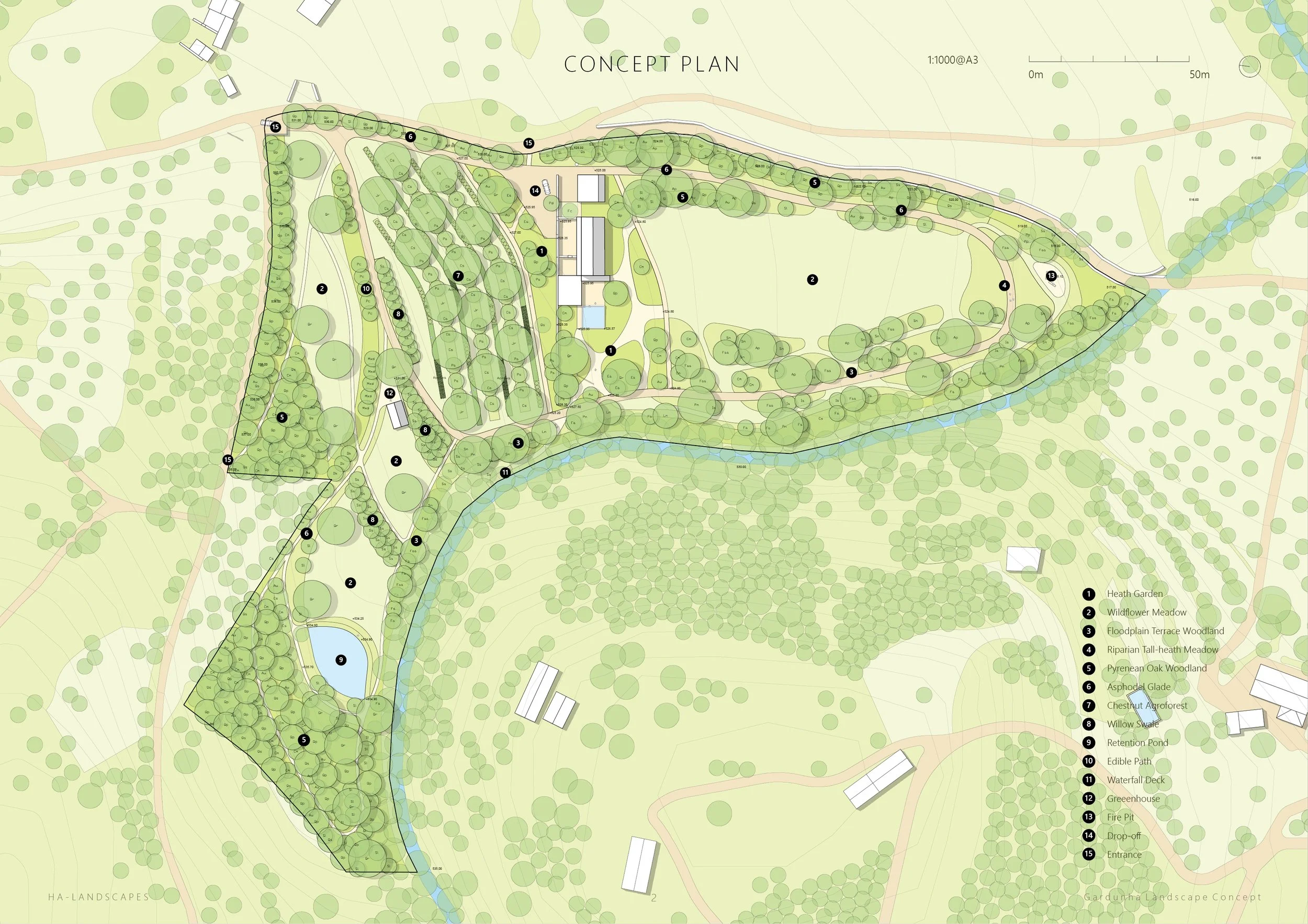
Concept Plan
The design approach for the Gardunha project began with a systematic analysis of the Tormentosa Valley and the uplands surrounding Fundão, undertaken to establish an appropriate spatial structure for a site, which currently presents itself as a blank tabula rasa, absent of any features. The land-use mosaic immediately adjacent to the site comprises riparian gallery forest, open floodplain pasture, maritime pine and eucalyptus plantations, broom thickets, and small remnants of Pyrenean oak woodland. Closer to Fundão, the landscape transitions into a patchwork of cherry and chestnut orchards interwoven with woodland-edge habitats defining farm boundaries.
This existing pattern of land uses and habitats was interpreted and overlaid with the broader potential natural vegetation of the region to identify an optimal configuration for the project, one that responds to the established landscape character while reintroducing biodiversity that is currently absent or substantially degraded. The resulting proposal seeks to reconcile the existing cultural landscape of fruit orchards and meadows with a more resilient, semi-natural one, of heathland, oak woods, and riparian floodplain vegetation, creating a structure that supports ecological regeneration while remaining rooted in local land-use traditions.
The resulting design proposal is organised concentrically around the proposed architecture, as a sequence of naturalistic ecological gardens and orchards that interpret the native plant communities of Serra da Gardunha, supporting a biodiverse, resilient, low-maintenance landscape mosaic, matching the micro-conditions of the site.
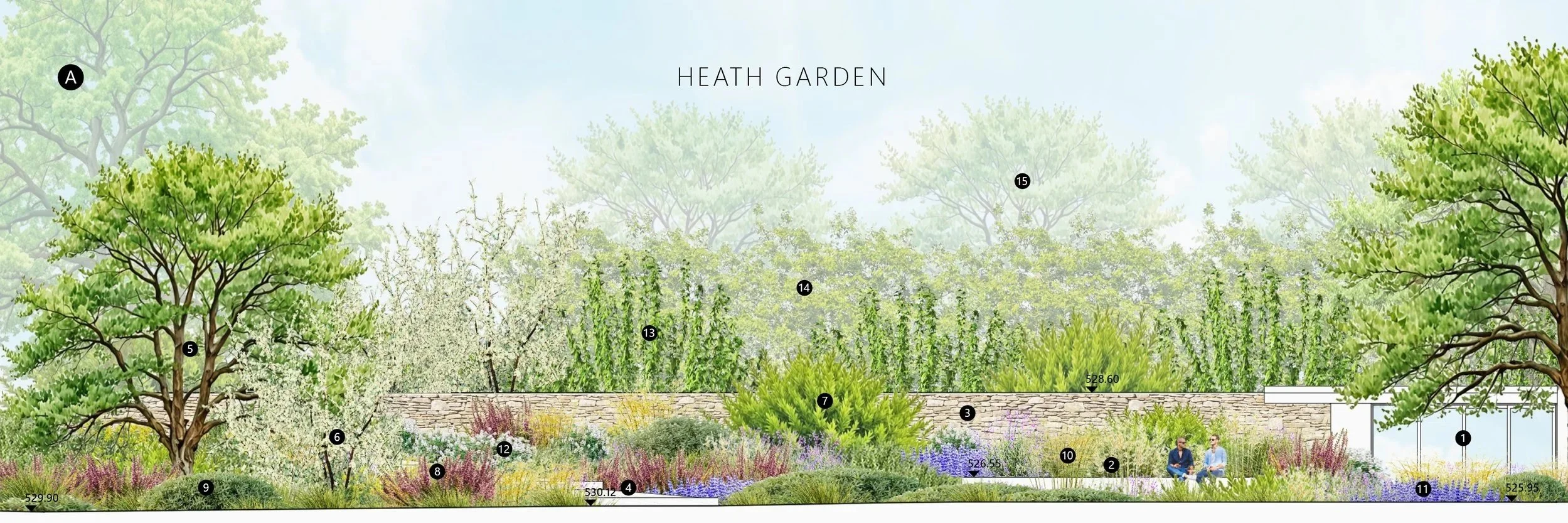
Closest to the house, the Heath Garden draws from the local Halimio ocymoidis–Ericetum umbellatae heathland, using drought-tolerant shrubs, subshrubs, grasses, and geophytes adapted to the locations dry, acidic, siliceous soils. A low evergreen matrix preserves views towards the mountain peaks from the house, and provides year-round structure. The garden surface is mulched in local crushed schist to maintain the low nutrient, well-drained conditions this community requires to thrive, whilst reducing maintenance, and suggesting a relationship between the materiality of the hardscape and the site’s underlying lithology.
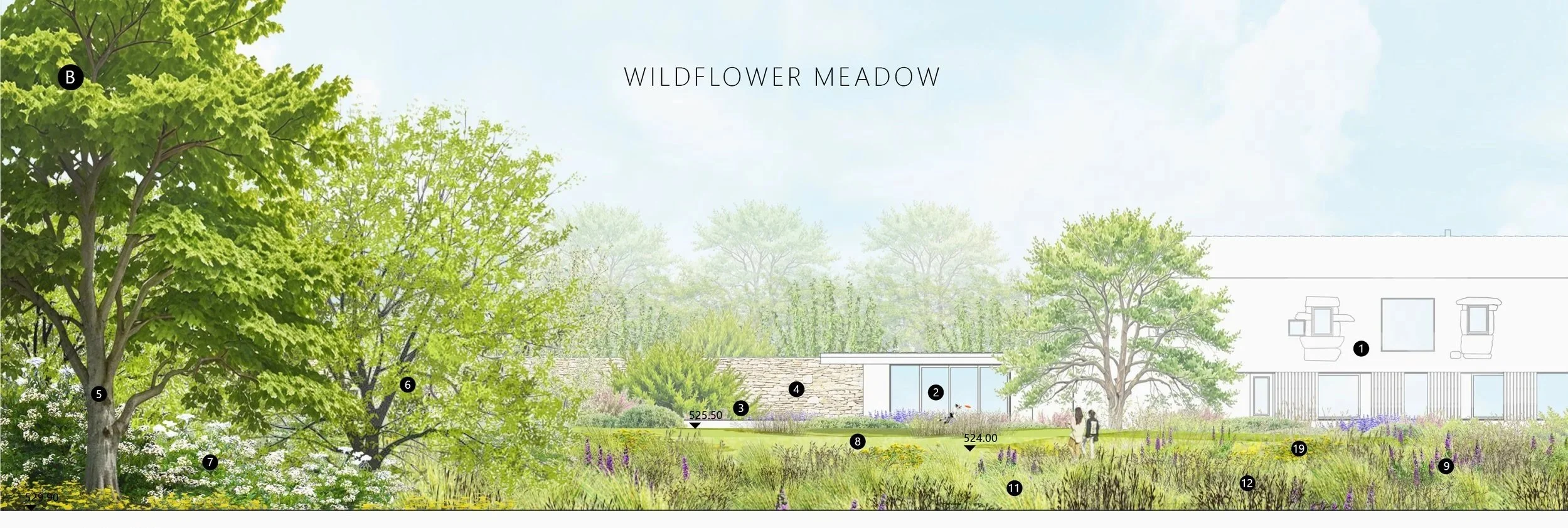
Adjacent to the Heath Garden, the Wildflower Meadows preserve the site’s open character, particularly north of the house where key views toward Serra da Estrela are maintained. Composed of herbaceous perennials and annuals typical of the region’s dry meadow communities, particularly the community of Dactylis hispanica subsp. lusitanica, the species predominantly present an early spring to early summer phenology, reinforcing a strong seasonal dynamic. Visually the meadows would be dominated by the quasi-endemic wildflower Echium lusitanicum, already present in small numbers along the site margins, with it’s striking lilac/magenta inflorescences. Maintained for high plant species diversity and invertebrate habitat, the meadows would be managed as a low-input system through mosaic mowing on a seasonal rotation. The mown section adjacent to the house provides utility for family use as a drought-tolerant lawn, whilst sections further away from the house present a more semi-wild character, replicating the patch qualities of natural meadows surrounding the site.
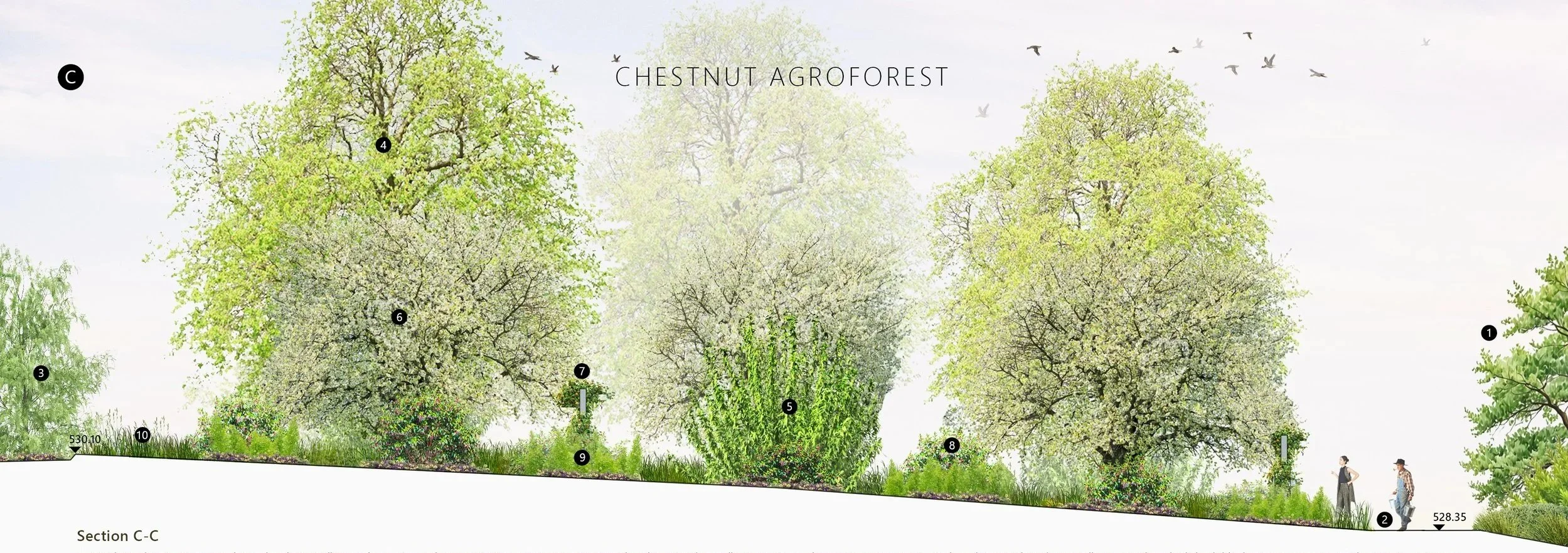
To the south of the house, the Chestnut Agroforest occupies a fertile ridge with loam soils rich in organic matter, following a keyline design informed by the traditional chestnut agroforests of central Portugal, know as Castanhais. Rows are aligned with the landform in an off-contour geometry to optimise hydrology and solar exposure, supported by swales that redistribute seasonal moisture downslope to the center of the ridge above the agroforest. The system integrates a polyculture of native fruit trees typical of the local region, with the canopy being composed of alternating chestnut and walnut trees, and the sub-canopy composed of sweet cherry dwarf cultivars, and coppiced hazel. The understorey is composed of northern high-bush blueberries, red raspberry trellises, asparagus and strawberry beds, and annual vegetable beds, organize along the rows in a staggered repeating formation. A ‘native wildflower path’ occupies the alleys, which maintains harvest and pruning accessibility, encourages biodiversity, and improves soil structure.
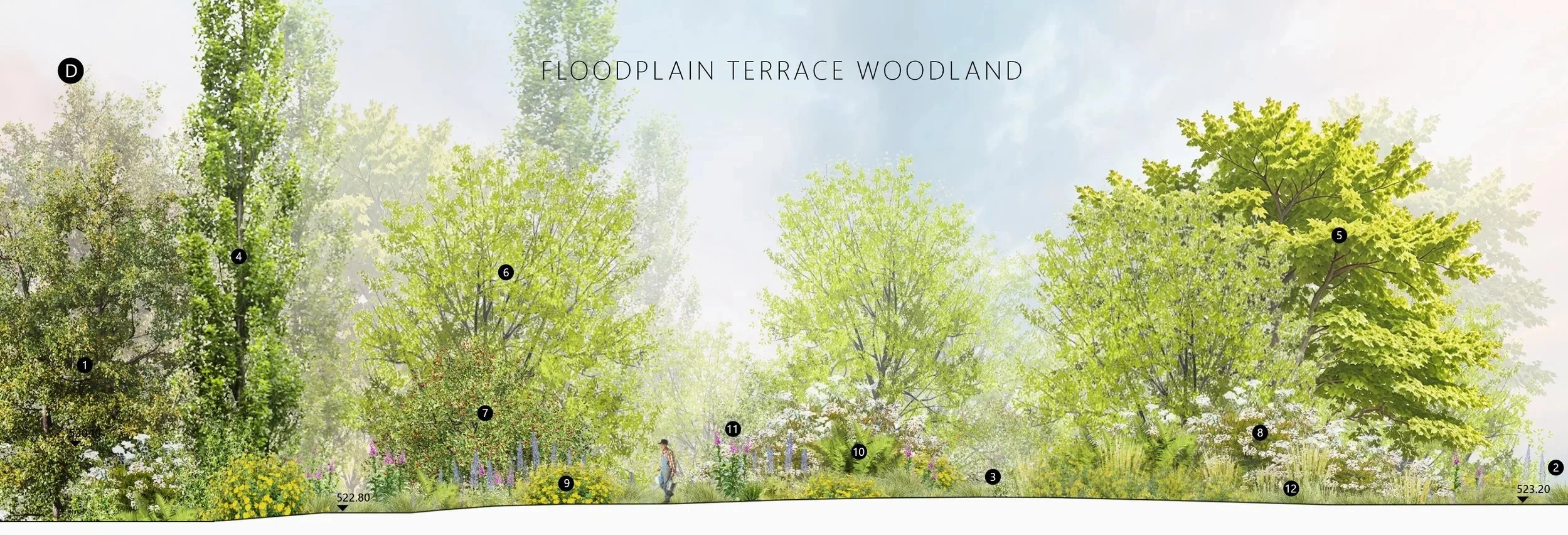
Along the full length of the Ribeira de Tormentosa, the project restores a Floodplain Terrace Woodland, reintroducing the lost ash–poplar component of the riparian community Scrophulario scorodoniae-Alnetum glutinosae, parallel to the existing alder gallery. The intended result of this intervention is the creation of a cool, shaded, summer-green oasis with an open canopy, and partially shaded, lush woodland understorey dominated by Europe’s tallest fern Osmunda regalis, the gracefully arching shrub Hypericum androsaemum, and a mat-forming groundcover of Viola riviniana, and Hedera hibernica, interwoven together with mown meadow paths. The layout of the garden follows the river, with the meandering paths moving between the existing river embankment, the terrace woodland, and the wildflower meadow. The character of the garden would provide an intimate contrast to the open, expansive views of the mountains experienced from the main wildflower meadow.
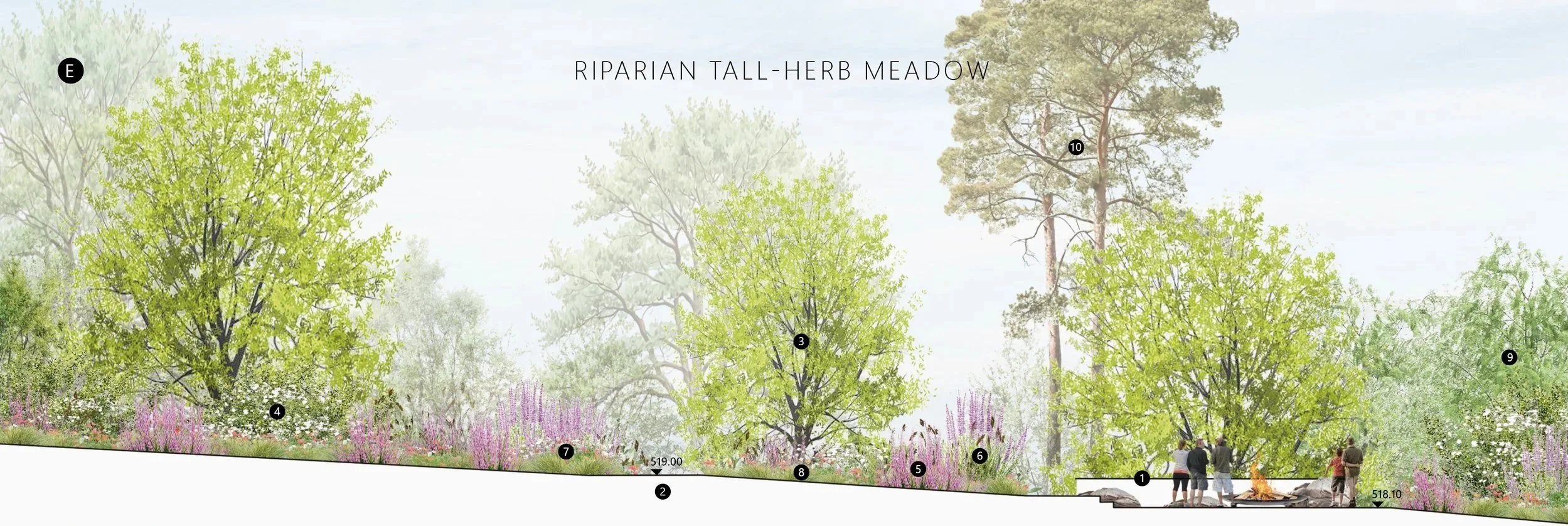
The Riparian Tall-Herb Meadow forms a sheltered gathering space with a fire pit area at the northern edge of the Flood Terrace Woodland. Open views are maintained to the north towards the snowcapped peak of Torre, with existing tree clusters framing the view. A low seating wall encloses the fire pit area, with large granite rocks placed throughout for informal seating, and as a reference to the surrounding mountain geology. The garden is composed predominantly of tall riparian herbaceous perennials associated with the poplar/ash woodland community, including Lythrum salicaria and Lysimachia vulgaris, with a strong summer to early autumn phenology. The planting is established into the existing meadow vegetation, which acts as an informal matrix. The herbaceous perennial biomass would be retained into mid winter before pruning, taking advantage of the aesthetic qualities of the frost covered stems and dead flower heads, whilst providing forage and habitat for local fauna. Ash trees and wild rose bushes would frame the space, creating a sheltered niche for year round use.
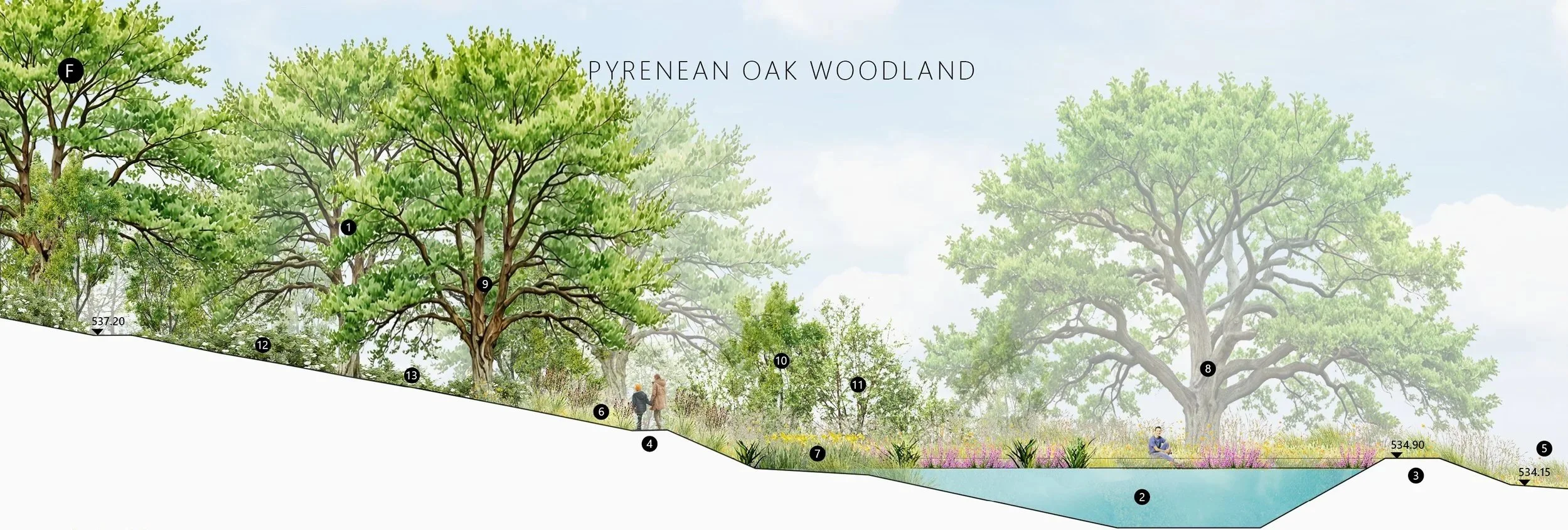
Along the western flank of the property, and further upslope to the south, the proposal aims to re-establish a Pyrenean Oak Woodland, a historically coppiced deciduous–marcescent oak forest that once formed the regional climax community, traditionally maintained as a charcoal producing agroforestry system know as Touças. This woodland, specifically modeled around the Arisaro simorrhini-Quercetum pyrenaicae community, would greatly enhance biodiversity, provide privacy, and form a natural fire buffer, while supporting the reintroduction of the vulnerable tree Sorbus latifolia.
Within its clearings, the Asphodel Glades create habitat for the endangered Asphodelus bento-rainhae, establishing a new population nucleus in collaboration with regional conservation partners.
The site’s hydrology is further supported by Willow Swales, which capture and redistribute runoff to the agroforest, and a Retention Pond located at the valley keypoint. With an estimated capacity of 270,000 litres, the pond would supply gravity-fed irrigation for the agroforest, whilst providing an essential water reserve during drought, power loss, or fire.
Timeline 2025-27
Location Serra da Gardunha, Castelo Branco
Site area 3 hectares
Project Type Private residence
Architect www.pedrobrigida.com